
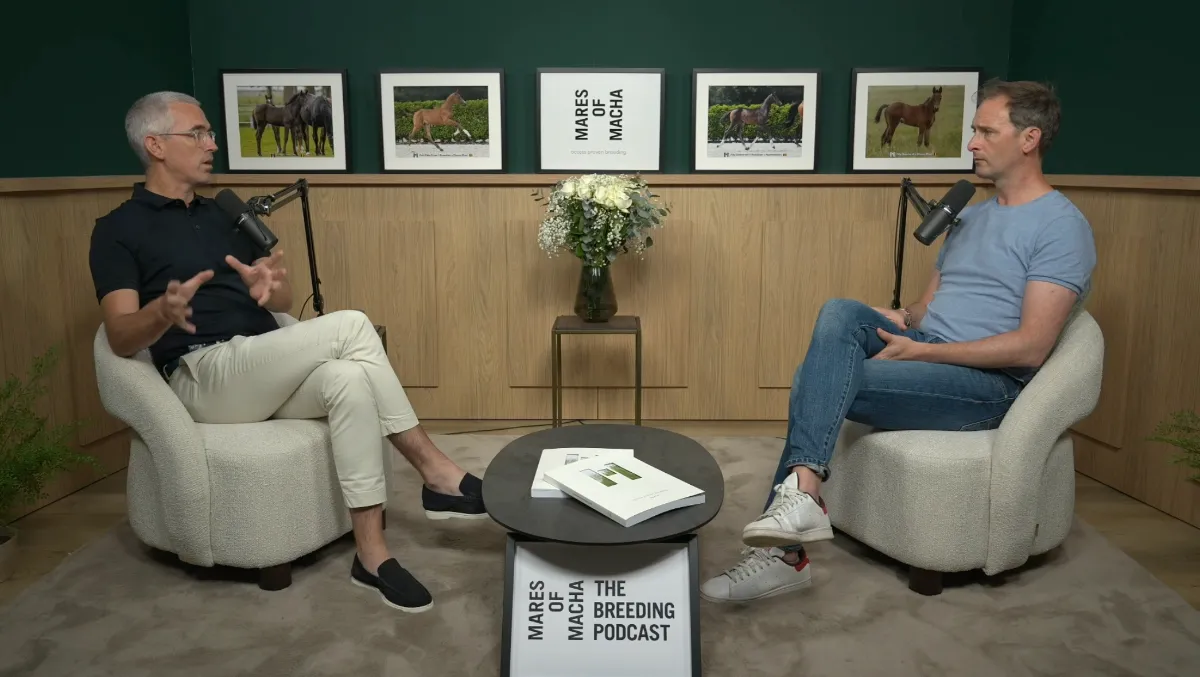
“Look at the data — society and successful entrepreneurship are built on data. Look at the allure of the horse, the type, what the horse is doing. And never forget to follow your intuition, because that's where breeders make the difference.”
Ingmar De Vos, President of the FEIWhat the data tells you
Sport results, dam lines, offspring statistics: the foundation of every good breeding decision is measurable. That is why, at Mares of Macha, we apply three hard criteria to every mare in our collection. She jumped at the highest level herself. Or she is the dam of horses that do. Or she comes from one of the rare, exceptional dam lines that produce top horses generation after generation.
And that foundation grows stronger every year. The FEI is currently linking studbook data to its own competition databases — the German breeding records have already been integrated, and other studbooks will follow. The stated goal: to offer breeders better services when they want to investigate which bloodline to continue. Tomorrow's breeder will have more, and more reliable, data at their disposal than ever before.
What the data doesn't tell you
Yet De Vos immediately adds a warning: sports data is by definition running behind. Results tell you what a horse has done, not what its offspring will do. So also look at what lies behind the numbers — the type, the presence, the way a horse does its job.
It is exactly what Klaas De Coster, co-CEO of Mares of Macha, describes in the episode. For us, data is the starting point — “the most important thing there is” — but that is where the real looking begins. Take mares like Carlina, who jumped at the highest level under Pius Schwizer, or Sancha LS of Daniel Bluman, or the horses of Henrik von Eckermann and Peder Fredricson: the data explains where their quality lies, but anyone who sees them, who walks into the stable or into the field in Italy, simply feels that these are different horses. You don't see that in a table; you feel it at the ringside.
Why this matters more today than ever
There is a reason this double perspective is becoming more urgent. The sport of 2038 will demand — as De Vos outlines elsewhere in the conversation — horses that are more technical, more careful and easier to deal with. Qualities like attitude and rideability barely appear in a results database, yet they will soon help decide who wins. Or as Klaas puts it: if everything in the sport becomes more delicate, the base you start from must have the greatest possible chance of getting somewhere. That base is the dam line.
And perhaps the finest confirmation from the episode: the man who advises everyone to look at the data wants to start breeding himself after his retirement — with his own ideas about bloodlines that he is not yet willing to reveal. Even the administrator becomes a breeder once the feeling starts to itch.
Why you need both
Data without an eye for the horse produces well-behaved averages. Gut feeling without data is gambling. The combination — rigorous selection on proven performance, complemented by the eye of people who stand among the horses every day — is how we build our collection, and how you as a breeder make your choice: the dam line is a given, the choice of stallion is yours.
Discover the collection and the available embryos on our website.