
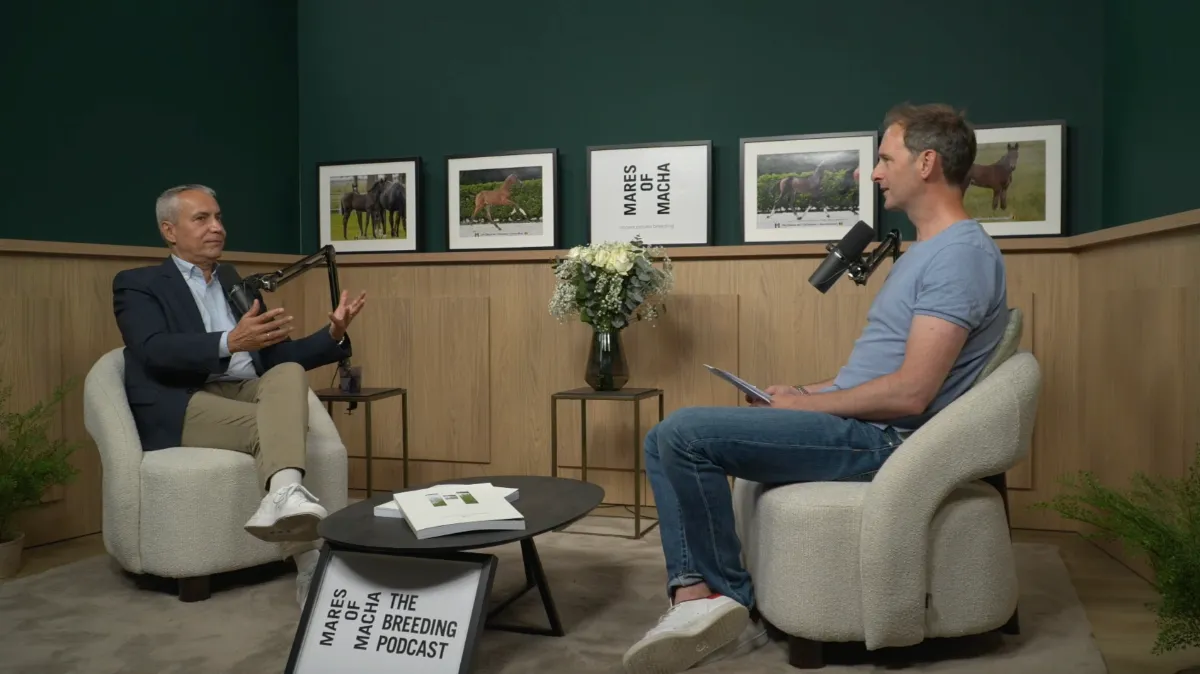
Breeders lay the genetic foundation of the sport. But the moment a horse jumps Grand Prix, the recognition — and the value — goes to riders, owners and dealers. It was the most-asked community question in our podcast with FEI President Ingmar De Vos. His answer was strikingly candid.
“I fully understand and I even support that request”
De Vos doesn't dance around the frustration: you breed the horse, you sell the foal, and when the big results come you're standing on the sidelines.
“Then it becomes a top horse, the big jackpot — and you don't get anything of it. I fully understand that frustration.”
Ingmar De Vos, President of the FEIBreeder premiums have been tried before, in Belgium among other places. They ran aground on three problems. The breeder was often not registered, or registered incorrectly — some studbooks don't record the breeder at all. The premiums were based on prize money rather than on the horse's sale price, which kept the amounts too small to make any real difference. And the data foundation needed to organise it fairly simply wasn't there. The principle already existed; the execution failed.
Why the FEI won't impose a premium
Anyone hoping for a quick ruling from above should read De Vos's answer carefully. As he sees it, the FEI's role is not to impose a measure because one party asks for it while others are against it. “What we need to do is bring the relevant people together” — riders, owners, dealers and breeders — and work out together whether a solution exists that everyone can stand behind.
Do riders and owners understand the breeder's needs? Does the breeder understand the position of the athletes and the trade? It sounds slower than a decree, but it's the only route that has ever worked in this sport.
What is actually happening now
Three things are moving.
One: the data
The FEI is integrating studbook data into its own systems — the German breeding records from Warendorf are already connected, the extension to the French Selle Français is under way, and talks with the Belgian BWP are ongoing. That sounds technical, but it is the foundation of everything: in many databases the breeder has until now been a free text field, producing spelling errors and duplicate entries. If you are not in the data correctly, you can never be recognised — let alone compensated.
Two: visibility
At FEI events such as the World Cup, the championships and the Longines League of Nations, the breeder already appears in the in-arena graphics, alongside the owner and the groom. The bottleneck is television: the FEI makes that data available free of charge to every organiser, but broadcasters themselves limit the number of graphics on screen — all the more so now that more and more people watch on a tablet or a phone. The will is there; the route runs through the broadcasters.
Three, and most important: the conversation
The FEI Sports Forum in Lausanne will host a dedicated session on the role of the breeder in April 2027, with riders, owners and the trade around the table — on recognition, and on a fairer share of the value. The timing is no coincidence: within the FEI–WBFSH Council, the finding on the table is that less is being bred and that breeders feel left behind. The issue is now officially on the sport's agenda.
Why this matters now
The call for recognition isn't new, but it is getting sharper. Breeders sell earlier and earlier in the chain, while the road from breeding product to Grand Prix horse is longer and more visible than ever. At the same time, foal numbers in Europe are falling year after year. A sport crying out for horses cannot afford to lose breeders who drop out because they stay invisible.
Why this concerns us
Every MoM client is the breeder of a future sport horse. The more visible the breeder becomes in the sport, the more valuable every well-considered breeding decision becomes — both sportingly and financially. We will be following the April 2027 Sports Forum closely and will keep you posted on every concrete step. Sign up for the newsletter so you don't miss a thing.